Sunday, September 6, 2015

Making Classroom Life Easier


WOW! I can't believe we are three weeks into the 2015-2016 school year! Every school year I try to implement something that will help me stay organized, something that will help our classroom run a bit more smoothly.  In this post, I would like to share a few organizational and classroom management tips and techniques that I use in my classroom with my students.

Pencils!

One of my "pet peeves" is sharpening pencils throughout the entire day! I've tried everything! Last year I gave each student a pencil pouch with 8 pencils and an eraser.  Every Friday I would collect these pouches, sharpen their pencils, and check to see if all eight pencils were still there AND in good shape.  If students had all 8 pencils, they would receive a "prize". This became more work for me, AND a few months into the school year students lost their pouches.  This year I'm trying something different.  I have two containers marked "Pencils that need sharpening" and "Sharpened Pencils".  I keep a supply of sharpened pencils in one container.  These pencils are marked to indicate "teacher's pencils".   Students sharpen their pencils before 9:00 a.m.  At 9:01 a.m. I unplug the pencil sharpener.  If students' pencils break or become dull they trade it in with a sharpened pencil. The broken or dull pencil is placed in the "Pencils that need sharpening" container.  At the end of the day "teacher's pencils" are returned to the container.   A designated student sharpens all pencils and places them in the "Sharpened Pencils" container.  Students' pencils are returned.   It's only been three weeks, but it seems to be working beautifully!  I don't have students sharpening pencils throughout the day.   If students need to replace their pencils they do so quietly.  No interruptions! Teaching and learning continue!


Click here to get these signs for your classroom!


Our Daily Schedule!

Having our class schedule displayed in the classroom keeps my students (and myself) focused!  I love color and clip art, so I created these signs using "free clip art" and formatting in Microsoft Word.  I have used posted schedules before, but these are large enough for ALL to see.  In fact, I see students looking at the schedule when finishing up one subject then prepare for the next one WITHOUT me prompting.  This saves time, time I can use to faciliate learning!

Click here to have access to these signs!

The Daily Five and our READING NOOKS!

I started using the Daily Five with my students about five years ago.  Daily Five is a "Readers Workshop" type of reading block. While I work with a small group or conference with individual students, the rest of the students choose Read to Self, Read to Someone, Work on Writing, Word Work,  or Listen to Reading (Computers).    I like to have my students comfortable when they read AND I do have many "comfortable" areas.  I created our "Reading Nooks" that my students rotate through.  Each student's name is on a clothespin.  Every morning as students enter class they will find their clothespin next to their reading nook for the day.  I NEVER have arguments over my various reading nooks!  
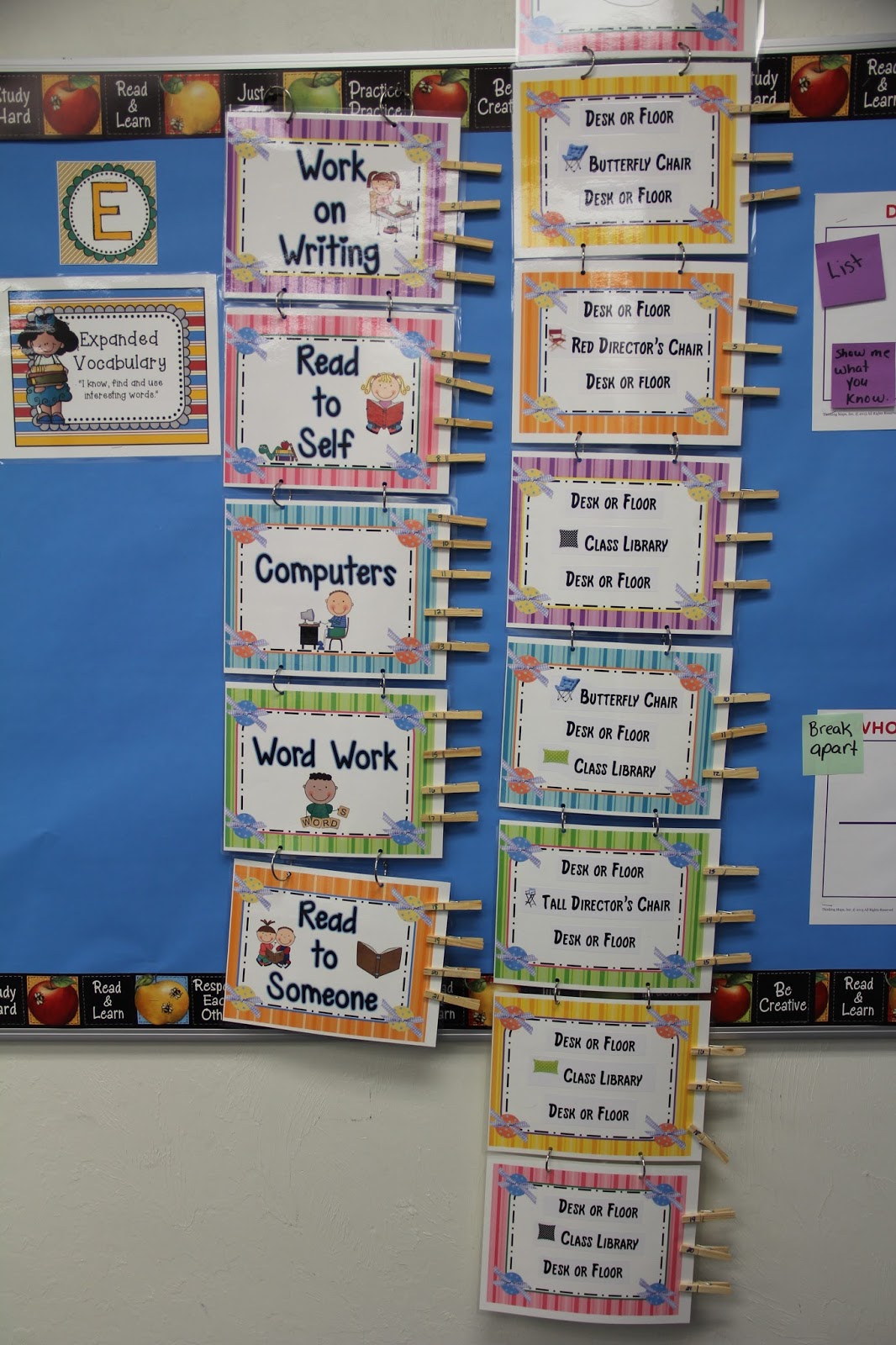


I found these wonderful signs here!  I took the blank signs and added my reading nooks!

CHAMPS

It didn't take me long to realize that many student's misbehaviors occur because I wasn't clear with my expectations!  WOW!  What a revelation!  CHAMPS allow me to make my expectations clear when it comes to voice level, seeking help, the activity, movement, and what participation should look like.  Once I implemented CHAMPs in my classroom the students knew what my expectations were and uninterrupted instruction took place.  Before any instruction or activity, I make my expectations clear by displaying signs.  C stands for conversation level.  Before an activity I would tell my students what I expected, 0 means no voices, 1 means students need to whisper, 2 stands for quiet voice, 3 stands for "teacher" voice.  I would then tell students what they need to do if they need help.  A is for activity, this tells students the activity they will participate in.  M is for movement.  This tells students if they can get water, go to the restroom, or if there is no movement. P stands for participation.  What should it look like?  If all expectations are followed then we will have success!  

With expectations established at the beginning of a lesson or activity, learning takes place as misbehaviors diminish!  If a student raises his or her hand to get water, I just quietly point to the expectation of movement.  His or her hand goes down, no interruption takes place, learning continues!  What a concept!


My CHAMPS posted in the front of the room!


Growth Mindset

After reading Mindset: The New Psychology of Success by Carol Dweck, I realized many students shut down academically because of a fixed mindset.  Many students give up due to fear of failure.   In a fixed mindset, students (people) believe their intelligence or talent are fixed traits.  Instead of developing their intelligence or talent, they spend time "documenting" them.  In a growth mindset, people believe that their most basic abilities can be developed through hard work and dedication.  They view intelligence and talent as the starting point.  "Growth Mindset" creates a love of learning!

To help cultivate a growth mindset in my students, I created a bulletin board entitled "Change your words, Change your Mindset"!   


If you would like these posters for your classroom, click here
I recently "revised" and updated these posters.  Please check them out!

In fact, just last week one of my students made a comment during math (we were working on rounding).  She said, "This is too hard, I can't "do" math"!  I quickly went to the mindset board and explain, "YES, you can"!  Instead of saying "This is too hard, I can't do math", let's say "This is going to take some time and I'm going to use some strategies to get this".  She smiled and agreed.

Also, to help create a growth mindset, I have this poster outside my classroom. 


If you would like to have this outside your classroom, please click here!
I am so excited for this school year!  I love to learn new things and implement them right away!  Stay tuned for learning strategies I'm implementing this year!


Sunday, August 16, 2015

The First Day of School

It's Sunday night, the night before the first day of school.  Lunches packed, clothes organized and school supplies ready for another year of learning.  Nope, not for my children.  My two boys are grown and finished with public school.  Tomorrow begins my 18th year of teaching, it's my 18th first day of school.  I still get excited, I still get butterflies, and tonight will be no different than the last 18 years; I won't be able to sleep.  I will lie there, my mind racing, wondering if I remembered to label that homework notebook, did I remember to purchase those clothespins for my "Daily Five" board, or did I remember to post my schedule.  Then my mind will go to my 22 students.  What do I want to accomplish this school year? What are my goals? 

I will instill a growth mindset in all 22 of my students.  My goal is to get my students to feel as if they can do anything, to do and be the best they can be!  I want them to take risks, get out of their comfort zone. I don't want them to be afraid to try new things.   Instead of saying "This is hard, I can't do this",  they will say "yes, this is hard so I'm going to use strategies to figure this out" or "It may take time and effort, but I will get this."  Having a growth mindset will enable my students to do anything and become anything.   I will also praise their effort and the processes they used in reaching their goal. According to Dr. Dweck, praising students effort will actually raise their IQ!  Having a growth mindset will propel my students to grow academically.  

Most importantly, my students will feel safe and loved!  Learning can not take place if students do not feel safe or if they feel the adult in charge does not care.  With 22 students, from 22 different households, I can not control what goes on outside of my classroom or school.  I can control what goes on in my classroom.  The moment my students walk through my door I want them to know they are important to me, that they matter.  A smile, a kind word, a gentle touch on the shoulder can change the course of a young student.  Nothing makes my heart smile more than when a student periodically says (in the middle of class) "I love you Mrs. Routten." I respond with, "I love you too!" 

Of course, I want my students to grow academically, but if my students adopt a growth mindset, if they feel safe, and loved, then the academics will take care of itself.

So, as I wind down on this night before the first day of school, I can't help but get excited thinking of the opportunities that will arise over the next 180 days and thinking about the 22 lives entrusted to me.  What a responsibility and what an awesome opportunity to make a difference!  

To all teachers, educators, and school staff, have an amazing and blessed school year!


Monday, July 13, 2015

Getting organized with chair pockets!

It's that time of year again...time to get my classroom ready! One of my favorite times of the year, because I have the opportunity to "tweak" things from last year and try new organizational ideas.  Today I spent about 3 1/2 hours just arranging desks and bookcases.  I ended my day by placing freshly washed chair pockets on the backs of my students' chairs.  Last summer I took on one of my favorite yet time-consuming projects.  As with most student desks, there isn't enough room for everything students need. That's when I decided to make chair pockets for each of my students.  These pockets slip over the backs of student chairs and include two pockets.  The small pocket hold students' library books, water bottles, pencil pouches, etc.  The larger pocket holds notebooks and workbooks.  

If you would like to attempt these pockets, follow the steps below.  Following the steps is an eight-minute video.  


I used 12 yards of fabric to make 21 chair pockets. First cut strips 18 1/2 inches wide from Salvage end to salvage end. Each strip is then cut into a 30-inch piece, a 13-inch piece, and a 10-inch piece.


Next, pin the smaller pieces to the 30-inch piece. Front side to the back side.


Stitch pieces together.


After the smaller pieces are stitched, it's now time to turn and finish the edges.


End of the smaller pocket turned.


End of the larger pocket turned.


Once the edges are turned, pull the top over and stitch the sides. This will create the "pocket" that will slip over the back of the chair.


Stitch the sides then turn it inside out. Your pocket is finished.


Finished chair pockets!


This is what it looks like on the backs of the chairs.  While measuring, I allowed a little extra in the width as I can always tighten it up.  Please keep this in mind when making your pockets.


This is an eight-minute video of how to make the chair pockets.


Please keep visiting my blog over the next month as I will continue posting additional organizational tips and "beginning of the year" classroom ideas.


Friday, June 12, 2015

Summertime!

YES!  It's summertime! Time to sleep in, go shopping, take trips, go to the beach EVERYDAY, and do absolutely NOTHING! Wait a minute, you mean we don't actually do all of this?  But that's what many people say we do.  Let me clarify, that's what many people (not in the education field) say we do.  Don't get me wrong, we do use the summer to "recharge" our batteries! However, the work continues! I'm going to do my best to provide a brief synopsis of what teachers ACTUALLY do during their summer break.


Professional Development

Teachers use a big chunk of summer break for professional development.  Whether it's reading professional books with colleagues, taking on line courses, completing college classes, or participate in "live" training, the learning continues.  

I just spent the last four days (of my summer break) with over 35 St. Lucie County teachers learning how to be effective teacher leaders to increase student achievement.  Next week, teachers from across our district will participate in collaborative planning training and over 45 teachers spent last Friday gaining knowledge and ideas about how to integrate STEM activities in their classrooms.  Sometime in July, I will be attending a Ruby Payne training along with other St. Lucie County educators.  The list goes on.  

Not only do we participate in "live" professional development, we also read professional books and journals to learn more techniques to use in our classrooms.  While reading these books, many educators take notes and practice some of these strategies in order to be ready to use them with students in August.  As of now I have a total of seven books I plan on completing by the time August rolls around.  


Finally, many teachers complete graduate courses during the summer.  Personally, I'm working on two classes.  One is on-line while the other will meet for one full week in Boca Raton.  I really don't mind as it will get me one step closer to a Masters in Reading!

Planning

Not only do educators spend a big part of their summer break improving their craft via professional development, we also plan for the coming school year.  This begins with reflecting on what worked this past school year and what didn't.  My grade group will join me at my house for a few days (not consecutively) to unpack the standards and plan for the first months of the school year.  Planning begins with looking at the standards.   What do we want our students to learn? What is the goal?  Then we look at how we are going to assess them. What will be some formative assessments and informative assessments?  Then we research best practices and choose activities, books, etc.  As you can see, planning is very time consuming.


Setting up the classroom

Contrary to popular belief, we are not given a week to get our classrooms ready before the students report.  At best, we are given two full days.  Most of us spend the last two weeks of our summer break in our classrooms cleaning, creating those bulletin boards, arranging our classroom libraries, distributing classroom supplies, etc.  


Finally, Vacation!

Yes, we do take vacation!  This is needed to recharge the "batteries" before a new set of 22 students enter our classrooms in August.  I usually carve out 2 full weeks of "fun in the sun", shopping, traveling, and just relaxing!


I just LOVE what I do and I happily do what I must in order to prepare for a new school year, as do many educators.  In the end, we do what we do for the students.

Sunday, May 31, 2015

"A Few of My Favorite Things"

With the 2014 - 2015 school year coming to a close, I sit back and reflect on what worked and what didn't work.  Straight away I focused on a few of my favorite strategies, both in academics and classroom management!  Here are my top  "Favorite Things" of the 2014 - 2015 school year (in no particular order)!  If anything sounds interesting to you and you have questions, feel free to email me or just post a question.  


  • Reciprocal Teaching - I absolutely LOVE using this strategy. (Please check out my post on Reciprocal Teaching).  Students read independently and record predictions, questions, clarifications and a summary.  After independent work, students have a group discussion.  I love the conversation I hear as I circulate and facilitate where needed.  Students actually teach one another.  For example, students were reading a passage on Calusa Indians and came to the sentence "many smaller tribes were constantly watching for these marauding warriors".  During the discussion a student needed clarification on the word "marauding".  Another student in that group said, "let's read the sentences to look for clues".  After reading the sentences that same student said "well, Calusas are fierce and war-like, maybe other tribes are afraid and watching that they don't get attacked.  So, I think marauding means fighting or attacking".  That student re-read the sentence using the word fighting and attacking.  Meanwhile, I just stood there and listened and watched.  Not once did I interrupt their thinking and talking.  While participating in Reciprocal Teaching ALL students are held accountable because ALL students must contribute to the group discussion. 

  • Close Reading -  This is a strategy I just began using this year. (Please check out my post on Close Reading).  Students read a passage three times.  The first time students read just to get the "gist".  While reading students code the text and look for words they do not understand. After the first read students have a discussion with their shoulder partner.  Students then read the passage the second time.  While reading the second time students have a task based on the structure of the text.  Students then have a second discussion.  Finally, students read the same text for a third time.  With the final read students have a task which includes a Thinking Map that will help them answer an extensive question.  After the third and final read, students have a final discussion with their shoulder partner.  Close Reading is usually spread across two or three days, depending on the length of the text.  

  • Document Based Questioning - Although this is one of the most difficult for the students, it is one of my favorites.  I saw so much growth in the students after the second unit.  Yes, it is difficult, however, the students can do it!  When DBQs are first introduced, I model the entire unit with gradual release.  The second unit, which usually begins in November or December, still has some modeling.  Students work with partner, then the last document analysis is done independently.  DBQs engage students in rigorous reading and writing,  student-centered lessons aligned with best practices and common core standards. With each document students search for EVIDENCE, ANALYZE that evidence, then use it support an ARGUMENT!

  • Thinking Maps - I absolutely LOVE using Thinking Maps. Let me rephrase that, I just LOVE it when my STUDENTS use Thinking Maps!  Thinking Maps are "Graphic Organizers". They are eight specific visual patterns that match eight different ways of "thinking" for deeper comprehension in all content areas.  The first few weeks of a school year, we practice using each map.  We discuss verbs that will determine the map to use for "that" particular thinking. When students work to determine the structure of a text, they can actually find the Thinking Map to use to organize their thinking, which will dictate the structure of the text.  About the second semester of the school year, students are able to choose the best Thinking Map to use to organize their thinking.  Once students record their thinking in a map, they "take it off" via discussion or a writing task.


  • Kagan Structures - Kagan Structures are cooperative learning strategies.  Using Kagan Structures is a favorite of mine because ALL students participate.  Not one student can "hide". All students are responsible to complete his or her portion of the task.  For example, one of my favorite Kagan Structure is the use of "Talking Chips".  I usually use this when students need to review previous taught content or if students need to process new information.  First, the teacher distributes three "talking chips" per student.   Any student in the group can begin the structure by placing a "chip" (can be a counter) in the middle of the group and then share one piece of content information.  That student can not go again until two other students from the group participates by placing a talking chip in the middle of the team.  Once a student's three talking chips are used, that student can not say anything until everyone in his/her group has used all of his/her talking chips.  This ensures ALL students participate.  This is just one structure of over 50 different Kagan structures.  (click on "Kagan" to visit their website).
  • Summative Assessment Contract - This is something new I used this year.  The idea came to me while at a conference last summer.  I saw this at a breakout session and adapted it to fit the needs of my students.   If a student didn't do well on a summative assessment, I analyze the errors then reteach that student using different strategies.  I assign additional practice for homework then retest.  The student completes the contract by responding to the following questions: What did you not understand?  Why did you not do so well on this assessment? What will you do next time?  Each question has responses to check and space for more explanation if needed.  Students must return contract signed by the parent(s) with completed additional practice attached.  At that time, the retest is administered.  Because this was new this year, I used it for math summative assessments.  When I first used this in the fall, I had about 9 students who needed this contract.  After about a month, that number declined to about 5.  About spring time, that number went down to 2.  I will definitely use this again next school year.  I would like to expand it to the other subject areas.
  • Celly - I would have to say that this was one of my favorites. My son's high school band director used this and, as a parent, I thoroughly loved it.  Celly is one of many applications that can be used to enhance parent communication.  I set up a free account, set up a group, and invite my parents to join.  Once joined I can send out mass texts.  For example, once I update my website with homework and spelling words for the week, I send out a text advising my parents of such.  Another example, I send out texts to remind parents of meetings, field trips, etc. If you would like to look into it further or set up a group, just click here!
  • Edmodo - This is a site I learned about in one of my graduate courses. Edmodo is a web-based platform that provides a safe and easy way for students to connect and collaborate with their peers and with the teacher. This is a safe sight controlled by the teacher. In the beginning of the year I set up an account and set up my class. A code is given and the students then sign on and set up their username and password. I usually use this to pose discussion questions on a book we are reading together in class. Click here to read interesting information!
Click here to go to the website

Saturday, May 9, 2015

The Best of Times...The Worst of Times

This time of year is so bitter sweet.  In a short three weeks I will say goodbye to 21 students, students who were a big part of my life for 180 days.  Each child is unique and will have a special place in my heart.


This coming Friday, May 15th, I will have a special presentation for my parents.  As I peruse photographs to use in this presentation, I am reminded of the many wonderful moments we experienced as a class, as a family; moments where I saw significant growth in my students as well as in myself.  This year I experienced some of the best and was reminded of one of the worst.

The highlight of my year, my career, was receiving the Milken Educator Award.  What an amazing day!  A day I will never forget; a day I was thrilled to share with my amazing students!  I was humbled, surprised, and blessed! But, the best part of the award is the growth I experienced as an educator and a person, even in these short four months.  This award gives me the desire to push myself beyond limits, limits I never thought possible.  I was selected to participate in our district's Aspiring Coaches Cohort.  This will afford me the opportunity to enhance teacher instruction, enhance educational practices, and increase student achievement at my school (as a classroom teacher, and a teacher leader). This honor also gives me the courage to take chances and "step outside the box" to reach ALL students. I'm not about the status quo! Finally, receiving this award confirms that teaching is what I'm suppose to do.


Here I am speaking to my students!  Pictured from left to right: First Lady Ann Scott,
Education Commissioner Pam Stewart, Dr. Jane Foley.
Pictured in the back: Mrs. Juanita Wright (Principal), Mr. Glenn Rustay (Milken Educator '00)

While choosing the music and lyrics for the photographs for the presentation, I was brought back to three years ago. (Music and lyrics tend to transport ones mind to the past).   This is when I experienced the worst as a teacher.  On March 26, 2012 one of our buses was involved in a horrific accident. About 12 students were transported to our local hospital and two were sent down south to a trauma hospital.  One student was killed.  That student was one of mine. Dealing with that loss was THE hardest thing I ever had to do.  My students were looking to me for comfort and strength, which I provided.  It took every ounce of strength I had (and the power and strength only my Lord can provide) to hold it together for them.  Once I arrived home I was able to let the emotions of the day take over. Even now, three years later, I still get emotional.  This event also shaped me as a teacher and a person.  I don't take time for granted.  I work hard to make sure ALL students feel loved, as if he/she is my favorite.

Will forever be in my heart!  We miss you!

I am blessed to work with phenomenal educators.  We are not only colleagues, we are a family. Every event, tragedy, and celebration solidifies this fact!

So, now I go back and work on this presentation for Friday.  I look forward to spending these next three weeks with the best group of fourth graders!  I will say my goodbyes then begin planning for my next group. But, until I welcome my new group of nine year olds, I will spend much needed time with my own family, my husband and boys!

Sunday, May 3, 2015

Response Chaining

This strategy has quickly become one of my favorites!  I must admit, I tried it last year and couldn't get it to work, so I quickly abandoned it.  With a new school year beginning I decided to visit this strategy again.  With the help of a colleague, we worked out what didn't seem to work last year and got it to work this year.  I do not use this strategy EVERY day, just occasionally.

This strategy is used to maintain my students engagement when asking questions or posing a situation. Response chaining links students' responses to questions.  This strategy begins with a question or prompt to which a specific student responds.  I then ask students to vote regarding the accuracy of the response using three options: thumbs up when the answer is correct, thumbs sideways if the answer is partially correct, or thumbs down if the answer is incorrect. For example, we have been working on main idea and summarizing.  After reading a short passage students write a summary sentence on an index card. While students are writing I circulate and look for a summary I can use response chaining with.  


I look for a decent summary, one that is accurate but lacking some information.  I display the card on the document camera, read it, and then ask students to show me (using their thumbs) if the summary is correct, incorrect, or something needs to be added. I tell the students that I shouldn't see any thumbs pointing down because the summary is correct or partially correct. 


After counting, 1, 2, 3 "show me", students indicate their response with their thumb.  The expectation is that ALL students must show me their thumb.  Of course I have students who will show me a thumbs up (saying the summary is correct) to avoid speaking or adding anything.  In order to keep ALL students engaged, I will also call on students with thumbs up to explain why they feel the summary is correct.

When students respond, they must paraphrase what the previous student said.  For example, after I put up a summary Student A will say "I partially agree with the summary, but I think we need to add the information about how trees provide shelter for animals".  After students show their thumbs, I will call on another student with a thumb turned sideways.  Student B will begin with "I heard Student A say to add information about how trees provide shelter for animals, but I think we also need to add something about how we can get medicine from the Rain Forest".  Again, students show their thumbs, I will call on a student with a thumb turned sideways.  Student C will begin with "I heard Student A say....", Student B said ..., I agree with them, but I also think we need to add...".

Depending on the task I will limit the question or "prompt" to four or five students.   After the last student paraphrases then add to the summary, I then have the students revise their own summary.


My students have used this strategy since about September.  It was challenging at first, but now students have developed excellent listening skills and can now add detail to their answers, summaries, and prompts.